AI Is Cutting Indian IT Jobs in 2026: How to Financially Prepare Before It Happens to You
A few years ago, “job loss” conversations in Indian IT meant recession fears borrowed from the US — Twitter layoffs, Amazon layoffs, a headline that felt far away. That’s not what 2026 looks like. This year’s job losses aren’t announced in press releases. They’re happening quietly, one performance review at a time, and the reason isn’t a slowing economy — it’s AI.
If you work in Indian IT, this affects you whether or not you’ve felt it yet. Here’s the actual data, and a concrete plan for what to do about it.
Table of Contents
- What’s actually happening in 2026
- The paradox: fewer conventional jobs, more AI hiring
- Building an emergency fund that fits this specific risk
- What happens to your health cover the day you lose your job
- Your EPF: what you can actually withdraw, and when
- Where to park your emergency money
- Don’t let a layoff wreck your investment plan too
- The other half of this plan: skill-proofing
What’s actually happening in 2026
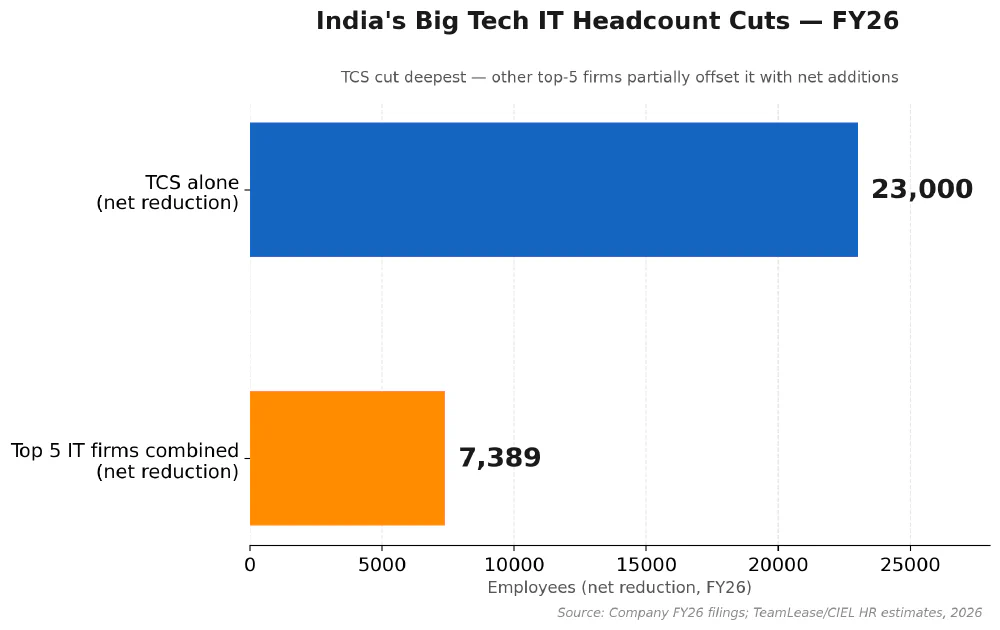
The numbers are no longer speculative. Roughly 1.28 lakh tech jobs were cut globally in just the first half of 2026, and India accounted for about 7% of that — the second-highest share of any country after the US. TCS, India’s largest software exporter, posted a net reduction of more than 23,000 employees in FY26 alone. Across the top five IT firms — TCS, Infosys, HCLTech, Wipro, and Tech Mahindra — combined headcount fell by roughly 7,400 in the same year.
Staffing firms TeamLease and CIEL HR separately estimate that somewhere between 25,000 and 35,000 technology jobs will be cut in India through 2026 — and most of it through what’s being called “silent layoffs”: performance-linked exits and quiet restructuring rather than public announcements. That matters for your planning, because a silent layoff gives you far less warning than a headline-making one.
The paradox: fewer conventional jobs, more AI hiring
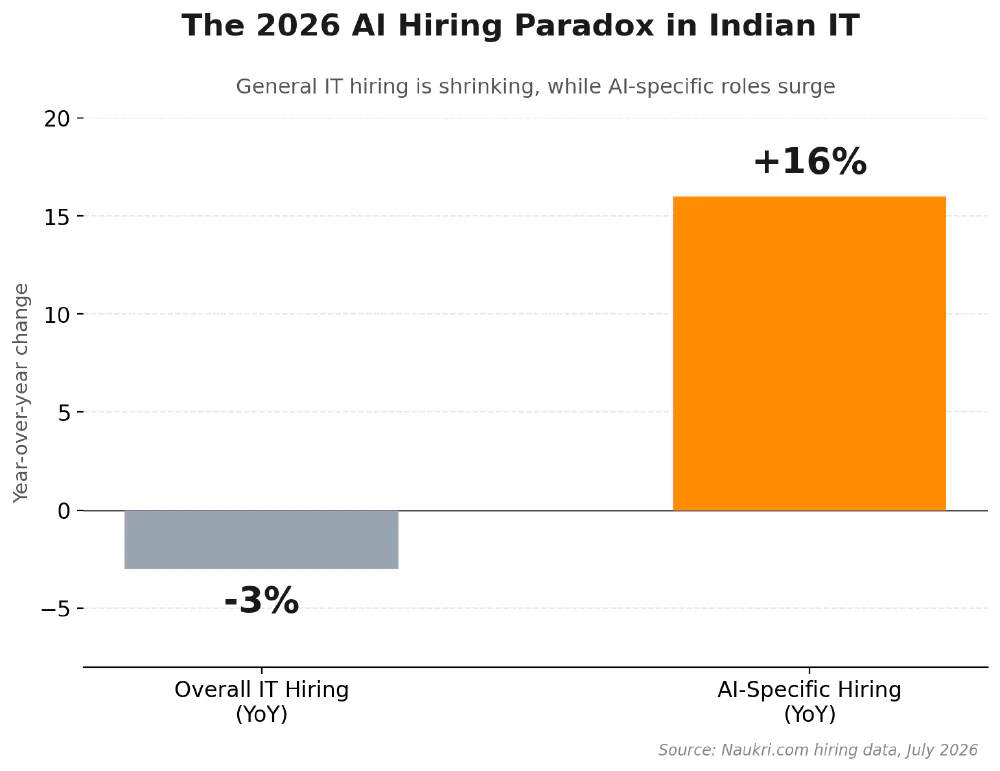
Here’s the part worth sitting with. While general IT hiring in India has actually declined slightly year-on-year, recruitment specifically for AI-related roles has grown by double digits over the same period. Companies aren’t hiring fewer people because business is bad — several are reporting strong results. They’re hiring different people, with different skills.
This lines up with what I wrote in 5 Skills AI Cannot Replace: AI isn’t eliminating jobs wholesale, it’s eliminating specific tasks, and the roles most exposed are the ones built entirely around those tasks. If your role sits squarely in that zone, this isn’t a “might happen” — it’s a “when.” Plan your finances accordingly, and separately, start reskilling now rather than after the fact.
Building an emergency fund that fits this specific risk
The standard advice — three to six months of expenses — was built for a world where layoffs came with a notice period and a severance conversation. Silent layoffs don’t work that way. You may see it coming only weeks in advance, if at all.
Given that, I’d push the target higher than the textbook number: aim for 6-9 months of essential living expenses if you’re in a role that touches routine coding, testing, support, or process-heavy work — the categories most exposed to AI substitution right now. If you have dependents (children, or parents relying on you), lean toward the higher end.
Do a liberal estimate, not a conservative one. It’s better to overshoot your target by a few months’ expenses than to discover mid-search that your number was optimistic.
What happens to your health cover the day you lose your job
This is the part people miss until it’s too late: most salaried employees are covered by their employer’s group health insurance, and that cover typically ends the day you leave — not at the end of the month, not with a grace period. If you or a family member needs care during your job search, you could be paying out of pocket at exactly the wrong time.
The fix is straightforward: carry an independent family floater health policy alongside your employer cover, even while you’re employed. It costs relatively little annually and means your health coverage doesn’t depend on your employment status at all.
Separately, if you’re covered under the ESI Act (this generally applies below a certain wage ceiling, so many salaried IT professionals aren’t eligible), ESIC’s unemployment relief scheme — the Atal Beemit Vyakti Kalyan Yojana — has just been extended through June 2027, paying roughly half of average wages for up to 90 days, once in a lifetime, for eligible insured persons. It’s worth knowing this exists, but don’t build your plan around it if you’re not sure you qualify — check your ESI status directly rather than assuming.
Your EPF: what you can actually withdraw, and when
Your EPF is not a substitute for an emergency fund, but it is a real backstop — and the withdrawal rules changed meaningfully under EPFO’s 2026 reforms. As of this year, members facing job loss can withdraw up to 75% of their accumulated balance fairly soon after becoming unemployed, with the remaining 25% released after a longer continuous unemployment period (this final-tranche waiting period has been reported differently across sources during the rollout, so confirm the current figure on the EPFO member portal before you rely on it).
You’ll typically need Form 19 for final settlement and Form 10C for your pension component, both submittable online through the EPFO Unified Member Portal using your UAN. Because EPFO 3.0 is still rolling out through 2026, treat the exact percentages and waiting periods as directionally correct and verify the live numbers when you actually need them — don’t plan against a number you read once, months ago.
Where to park your emergency money
Once you’ve built the fund, where it sits matters. I’d split it three ways:
- Immediate cash — a small amount in hand or in a basic savings account for same-day needs.
- A sweep-in fixed deposit — linked to your savings account so it auto-liquidates against ATM/UPI withdrawals if you need it fast, while still earning FD interest sitting idle.
- A liquid or overnight mutual fund — for the portion you’re confident you won’t need in the next few days, earning a bit more than a savings account with next-day redemption.
Don’t put emergency money into anything with lock-in periods or market volatility — the whole point is that it’s there, intact, on the day you need it.
Don’t let a layoff wreck your investment plan too
Job losses have an unpleasant habit of coinciding with market downturns — precisely the moment your portfolio is also looking its worst. If you’ve been reading my posts on the Nifty and gold/silver volatility earlier this year, you’ve already seen this play out.
The fix isn’t timing the market — it’s having an asset allocation you set before the stress hits, and sticking to it regardless of headlines. If you need a portion of your money in the next 3-5 years, that portion should already be mostly in fixed income, not equity, so a layoff doesn’t force you to sell stocks at the worst possible moment. If you’re investing for the long term — including through US stocks from India — a layoff shouldn’t change that allocation at all, as long as your emergency fund is doing its job separately.
The other half of this plan: skill-proofing
An emergency fund buys you time. It doesn’t fix the underlying exposure. If your current role sits in the category most affected by AI substitution, the honest next step is building toward the skills that are still in demand — which is exactly what I covered in 5 Skills AI Cannot Replace. Read that alongside this one; they’re meant to work together.
Disclaimer: This article is published by ChandraS EDU for general informational and educational purposes only and does not constitute financial, legal, or tax advice. I am not a SEBI-registered investment advisor. Specific figures around EPF, ESIC, and other government schemes are subject to ongoing regulatory changes in 2026 — verify current rules on the official EPFO (epfindia.gov.in) and ESIC (esic.gov.in) portals before making decisions. Please read our full Disclaimer for more details, or reach us at mailchandrasedu@gmail.com.