How to Invest in US Stocks from India: The Complete Guide
For years, I told myself Indian markets were enough. Then two things changed my thinking completely.
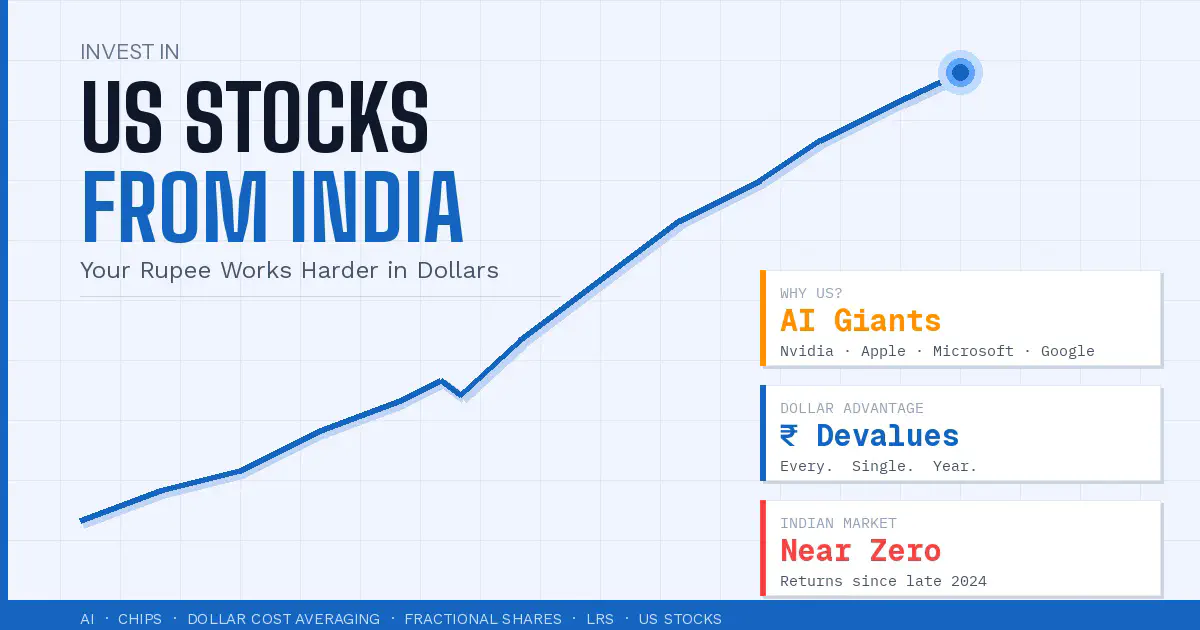
First, Nifty 50 has delivered close to zero real returns for investors who entered in late 2024. The index touched 26,000, corrected sharply — touching a low near 22,200, and has struggled to recover. Midcap and smallcap indices — where the “wealth creation stories” were loudest — have corrected 25–35% from peaks. Meanwhile, anyone with US exposure watched their portfolio quietly compound.
Second, I started thinking seriously about AI. And it became obvious fast — the AI revolution is a US story, not an Indian one.
If you believe the future is in AI, investing only in Indian markets means sitting out the biggest wealth-creation opportunity of this decade.
Why US Stocks Make Sense Right Now
Returns and Rupee Depreciation
Over the last 15 years, Nifty 50 has delivered ~12.5% annually. S&P 500 has delivered 13.9%. Nasdaq 100 has delivered 17.5% — nearly 5% more than Nifty.
But here’s what most people miss. The Rupee has devalued from ₹46 to ₹88+ per dollar over 15 years — roughly 4% annually. If an Indian investor put money in Nasdaq 100, the effective return in Rupee terms works out to around 21% annually. Meanwhile, Nifty 50’s returns in dollar terms drop to just 7.5%.
Your iPhone, your laptop, crude oil, gold — all priced in dollars. Owning some dollar-denominated assets isn’t optional anymore.
The AI Revolution Has No Indian Address
This is the most important argument for US stocks right now.
Every company at the center of the AI wave is American:
Chips (the foundation of AI): Nvidia ($4+ trillion valuation, up 600% in 2 years), AMD, Broadcom (custom AI chips for Google and Meta), Intel.
AI Platforms: Microsoft (invested $13B in OpenAI, Copilot in every product), Google (Gemini, TPU chips, Cloud AI), Meta (Llama models, AI-powered ad platform), Amazon (AWS Bedrock, AI logistics).
AI Infrastructure: Palantir (up 400%+ in 2 years), ServiceNow, Snowflake.
Now compare this to Indian markets. Nifty 50 is 36% financials — banks and insurance companies. Technology is just 11% — and that’s TCS, Infosys, Wipro, whose business model of selling human hours is exactly what AI threatens to automate. They are more exposed to AI disruption than they are beneficiaries of it.
One data point: Nvidia’s valuation alone is $4 trillion. India’s entire stock market is ~$5 trillion. One US company is nearly equal to every listed Indian company combined.
If you want AI exposure, you have to look at US markets. There is no other way.
The Methods Available: Quick Overview
Indirect Methods (Mutual Funds and ETFs)
International Mutual Funds like Motilal Oswal Nasdaq 100 and Franklin US Opportunity work like regular MFs, but India’s government caps total foreign MF investment at $7 billion (hit in 2022, never revised). Many funds have stopped accepting fresh investments. About 19 are still open — but this changes without notice. Not reliable for systematic investing.
Domestic ETFs tracking global indices (only 6 exist in India) face a $1 billion cap. Because fund houses aren’t always creating new units, you risk buying old units at a premium in the secondary market. In April 2025, some ETF premiums crossed 20%. Requires careful monitoring — not beginner-friendly.
GIFT City Funds are a new option (DSP Global Equity Fund launched June 2025) with no regulatory cap, but minimum ₹5 lakhs and still largely untested.
The common problem with all indirect methods: Government regulation makes them unreliable for regular, systematic investing.
Direct Investment — The Right Long-Term Approach
This means buying US stocks and ETFs directly. Your individual limit under RBI’s Liberalised Remittance Scheme (LRS) is $250,000 per year (~₹2.2 crores) — completely separate from the $7 billion MF industry cap. You own actual shares — Apple, Nvidia, VOO — not units of an Indian fund.
You can open accounts with international brokers like Charles Schwab or Interactive Brokers directly, but the process involves heavy documentation, wire transfers, currency management, and self-managed Indian tax compliance. It’s doable but has a learning curve.
Why INDmoney Is the Smartest Starting Point
INDmoney works as an intermediary between you and US brokers like Drivewealth — and they’ve removed almost every friction point.
Account opening: Fully digital using PAN and Aadhaar. No confusing international forms. Done in under 10 minutes.
Sending money: No wire transfers. They handle LRS compliance and remittance in a guided flow from your Indian bank account.
Tax compliance: LTCG, STCG, TCS reporting — all managed locally within the app. They generate ITR-ready statements including Schedule FA for foreign asset disclosure.
Portfolio view: Your Indian and US investments visible in one place.
You pay slightly more in brokerage than a direct international broker — but what you save in time, errors, and stress is worth it for most investors.
Open your INDmoney account here — takes under 10 minutes and the first steps are free.
What You Can Buy
Once your account is active:
- Individual US stocks — Apple, Nvidia, Microsoft, Amazon, Google, Meta, and thousands more
- US ETFs — VOO/SPY (S&P 500), QQQ (Nasdaq 100), sector ETFs, dividend ETFs
- Fractional shares — invest as little as $1 and own a fraction of any stock
Even with ₹5,000, you can start building real exposure to the AI revolution.
Three Powerful Advantages Indian Investors Underestimate
1. Fractional Shares — You Don’t Need to Be Rich to Start
One of the biggest mental blocks Indian investors have is price. “One share of Google costs $170. One share of Amazon costs $200. I can’t afford that.”
Fractional shares solve this completely.
With INDmoney, you can buy ₹500 worth of Nvidia even if one full share costs $130. You own a fraction of the share, get proportional returns, and can build positions gradually over time.
This changes everything for salaried investors. You don’t need a lump sum. You invest what you can, when you can, and accumulate over months.
2. Dollar Cost Averaging — The Ideal Strategy for US Stocks
Dollar Cost Averaging (DCA) means investing a fixed amount at regular intervals — say ₹5,000 every month — regardless of whether the market is up or down.
This works especially well for US stocks because:
- You buy more units when prices are low, fewer when prices are high — automatically averaging your cost
- You remove emotion from investing — no guessing market tops and bottoms
- Currency timing becomes less critical — even if the dollar is temporarily expensive, you’re averaging your exchange rate over time
A simple example: invest ₹5,000/month in QQQ (Nasdaq 100 ETF). Some months you get fewer units at a high price, some months more at a lower price. Over 5–10 years, your average cost smooths out — and the compounding in dollars works powerfully in your favour.
INDmoney makes DCA simple with scheduled transfers and automatic investment options.
3. Rising Dollar — Your Silent Returns Booster
Most Indian investors focus only on stock returns and miss this completely.
The Rupee has moved from ₹46 per dollar in 2010 to ₹84-85 today — a depreciation of nearly 91% over 15 years, or roughly 4% every year.
What this means in practice:
| Investment | Return in Local Currency | Return in INR |
|---|---|---|
| Nifty 50 (15 yrs) | 12.5% annually | 12.5% |
| Nasdaq 100 (15 yrs) | 17.5% annually | ~21% |
That 4% annual Rupee depreciation adds directly to your US investment returns when you eventually convert back to INR. It’s not guaranteed to continue at exactly this pace — but structurally, the Rupee has weakened against the dollar in every single decade since independence.
Even if US stocks delivered zero returns, just holding dollar-denominated assets would have given you ~4% annually in Rupee terms.
This is the silent compounding engine that most Indian investors never account for — and it’s one of the strongest reasons to start US investing now rather than later.
Methods Compared
| Parameter | International MFs | Domestic ETFs | Direct (INDmoney) |
|---|---|---|---|
| Ease of use | Easy | Moderate | Easy |
| Regulatory limit | $7B cap (hit) | $1B cap | ₹2.2 Cr/year personal |
| Regular/SIP investing | Unreliable | Not ideal | ✅ Yes |
| You own the asset | No | No | ✅ Yes |
| Best for | One-time if open | — | Systematic investing |
Tax Rules — Quick Summary
STCG: Sell within 24 months → gains taxed at your income slab rate.
LTCG: Hold beyond 24 months → taxed at 12.5%.
Dividends: US companies withhold 25% tax at source. Claim credit while filing ITR to avoid double taxation.
TCS: 20% collected on LRS remittances above ₹10 lakhs/year (threshold raised from ₹7 lakhs in Budget 2025) — adjusted against your final tax liability, not an extra cost.
Foreign Asset Disclosure: Declare in Schedule FA of ITR. INDmoney provides the statements you need.
My Personal Investment Strategy: Buying US Dips with $5–10
I want to share what I actually do — not just the theory.
My approach is simple: whenever a US stock or index I track falls 2–5% in a day, I put in $5–10. That’s it.
No complex analysis. No waiting for the “perfect bottom.” Just a small, disciplined buy every time the market gives me a discount.
Here’s why this works particularly well for US markets:
US Markets Fall Hard and Recover Faster
One thing that surprises most Indian investors is how frequently and sharply US markets correct — and then bounce back. A 2–3% single-day drop in the S&P 500 or Nasdaq is not unusual. Earnings misses, Fed rate commentary, geopolitical news, even a single tweet from a CEO — all of these can trigger sharp intraday or overnight falls.
In Indian markets, a 2% fall on Nifty 50 is a significant event and often carries a bearish tone for days. In US markets, a 3% drop on Nasdaq in one session is sometimes fully recovered within 48 hours.
This means US markets actually create more buying opportunities than Indian markets — if you’re watching.
Why $5–10 Works (Fractional Shares Make It Possible)
Before fractional shares existed, this strategy was impossible for most Indian investors. One share of Nvidia costs ~$130. One share of Google costs ~$170. You couldn’t dollar-cost-average into these stocks with small amounts.
Now with platforms like INDmoney, you can put in exactly $5 and own a fraction of any stock. So when Nvidia falls 3% on a day, I buy $5–10 worth. When the Nasdaq drops 2.5%, I add $5–10 to QQQ.
Over time, these small purchases accumulate into a meaningful position — all bought at slightly better prices than the long-term average.
The Dip-Buying Framework I Follow
| Market Fall | My Action |
|---|---|
| 2–3% single day drop | Buy $5 in the index (QQQ or VOO) |
| 3–5% single day drop | Buy $10 in the index + check individual stocks |
| >5% (sharp correction) | Buy $10–20 if fundamentals unchanged |
| >10% over a week | Larger allocation, treat it as a gift |
The key discipline: I only buy stocks or indices I’ve already researched and believe in long-term. Dip-buying a company with deteriorating fundamentals is just catching a falling knife.
Why This Complements DCA
I don’t replace my regular monthly SIP with this. I run both:
- Fixed monthly amount via DCA — happens automatically regardless of market conditions
- Extra $5–10 on dips — opportunistic, happens when the market cooperates
The DCA builds my base position consistently. The dip-buying lowers my overall average cost over time. Together, they work better than either strategy alone.
The Psychological Advantage
Here’s something nobody talks about: dip-buying changes your relationship with market falls.
When Indian markets fall, most investors feel anxious or helpless. When US markets fall, I feel prepared — because I have a plan and the amount I’m putting in is small enough that it never hurts. Putting $5–10 on a dip feels like an opportunity, not a risk.
This mental shift — from fear to readiness — is honestly one of the biggest advantages of this strategy.
Note: This is my personal approach and not investment advice. Every investor has a different risk tolerance and financial situation. What works for me may not work for you. Always invest only what you can afford to stay invested in for 3–5+ years.
Getting Started
- Open your INDmoney account — PAN + Aadhaar, 10 minutes
- Complete KYC — guided process
- Start small — even $100 to understand the flow
- Pick your investment — for most beginners, VOO (S&P 500) or QQQ (Nasdaq 100) ETF is the right start
- Set a monthly amount — consistency beats timing
Don’t wait for the perfect entry point. The Rupee will be worth less next year. Starting small beats waiting for complete clarity.
FAQ
Is it legal? Yes. Under RBI’s LRS, every Indian resident can invest up to $250,000 per year in foreign assets.
Do I need a US bank account? No. INDmoney accepts Indian Rupees and handles conversion.
What’s the minimum? Technically $1 through fractional shares. Practically, ₹5,000–10,000 is a sensible start.
Final Thoughts
Indian markets are going through a rough patch. The AI revolution is playing out in the US. The Rupee is slowly losing ground. All three arrows point in the same direction.
You don’t need to put a large amount in US stocks — even 5–10% of your portfolio changes your risk-return profile meaningfully over the long term. INDmoney makes it genuinely simple to start.
Open your INDmoney account and start investing in US stocks today
Sources & References
- Nifty 50 all-time high (26,373, Jan 5 2026) and 52-week range — TradingView / Investing.com
- India market cap ~$4.4 trillion (Mar 2026) — CEIC Data
- Nvidia market cap $4.8–5 trillion (Apr–May 2026) — CNBC, CompaniesMarketCap
- Microsoft $13B funding commitment to OpenAI — Microsoft 10-Q, Oct 2024
- LRS limit $250,000 unchanged for FY2026-27 — KarbonCard / RBI
- TCS threshold ₹10 lakhs (raised from ₹7L in Budget 2025), 20% on investments above threshold — Upstox / Budget 2026 FAQs
- LTCG on foreign stocks: 24-month holding period, 12.5% rate (Section 112) — Winvesta, ClearTax
- USD/INR exchange rate ~₹84-85 (2026) — Multiple sources including Razorpay (₹83.38 RBI reference rate cited)
- Nasdaq 100, S&P 500, Nifty 50 long-term returns — Based on Motilal Oswal / YouTube source video; verify current figures before citing
Disclaimer: This post is for educational purposes only. I am not a SEBI-registered investment advisor. Please do your own research before investing. US stocks carry market risk and currency risk. The affiliate link above means I may earn a commission if you sign up — at no extra cost to you.