India AI Impact Summit 2026: US Partnerships & AI Launches
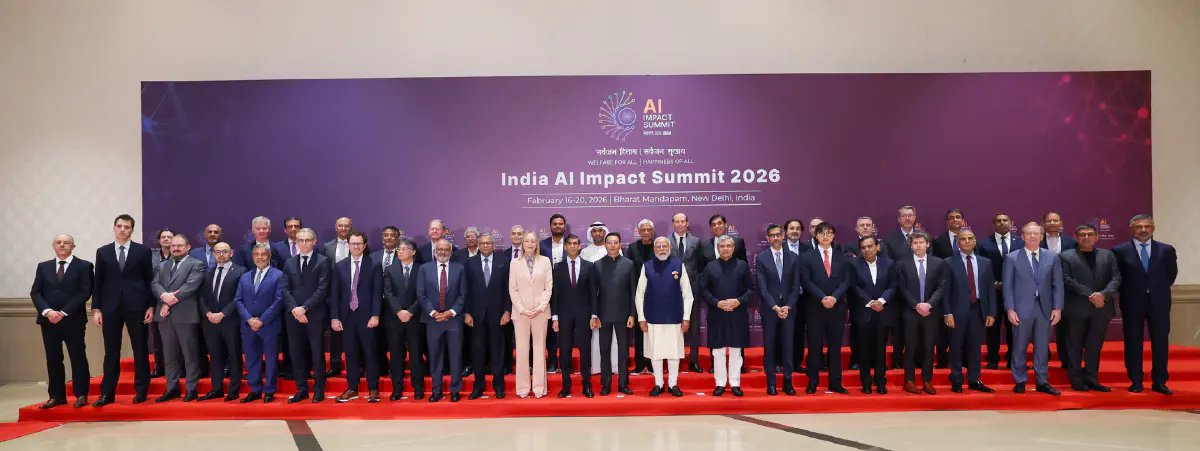
The world’s largest AI conference just wrapped up in New Delhi with over 300,000 attendees, and it delivered on three fronts: major US-India partnerships, indigenous AI product launches, and a clear signal about where tech jobs are heading.
Prime Minister Modi, UN Secretary-General António Guterres, and CEOs from OpenAI, Anthropic, Google, and Microsoft all showed up. But beyond the photo ops, concrete business deals were signed and actual products were unveiled.
Here’s what happened—and what it means for your career.
The Viral Moment Everyone’s Talking About
During a group photo on stage, OpenAI CEO Sam Altman and Anthropic CEO Dario Amodei stood side-by-side but refused to hold hands, instead raising fists separately while PM Modi held hands with other leaders.
The awkward moment went viral instantly. One venture capitalist tweeted: “When you’re forced to do a group project with your opp.”
Why does this matter? The competition between ChatGPT (OpenAI) and Claude (Anthropic) just landed in India, with both companies signing major partnerships with Indian IT giants.
Three Game-Changing US-India Partnerships
1. Infosys + Anthropic: Bringing Claude to Enterprise India
On Tuesday, Infosys announced a strategic collaboration with Anthropic to develop advanced AI solutions for enterprises. Infosys shares jumped 2% immediately.
What this means: Infosys will integrate Claude (Anthropic’s ChatGPT competitor) into business software for global clients. If you work at Infosys or for their clients, expect Claude in your workflow tools soon.
Jobs impact: Infosys needs engineers who can integrate Claude’s API, build custom AI agents, and train models on company data.
2. TCS + OpenAI: Building India’s AI Infrastructure
TCS partnered with OpenAI to build AI infrastructure in India, including a 100MW data center with potential to scale to 1 GW.
The scale: A 100 MW data center can power tens of thousands of high-performance GPUs for AI training. The 1 GW option means TCS could run 10 times that capacity.
What’s different: TCS isn’t just providing services—it’s positioning itself as an AI infrastructure provider, like Amazon Web Services but specialized for AI.
Career opportunities: Cloud engineers, DevOps specialists, and infrastructure architects will be in high demand across multiple Indian cities.
3. Microsoft + The Big Four: 200,000 AI Licenses
Microsoft announced that TCS, Infosys, Wipro, and Cognizant will collectively deploy over 200,000 Microsoft Copilot licenses—more than 50,000 per firm.
These aren’t ChatGPT subscriptions. This is “agentic AI”—intelligent systems capable of taking initiative, making decisions and generating insights autonomously with minimal human oversight.
The training push: Wipro has already upskilled 25,000 employees in Microsoft Cloud technologies. The other firms are doing the same.
The bet: These companies are wagering billions that AI will enhance employees, not replace them.
Made-in-India AI: Products Actually Launched
Sarvam AI Kaze Smartglasses
The moment: PM Modi became the first person to try Sarvam AI’s Kaze smartglasses at the summit expo.
What it does: The glasses listen, understand, respond, and capture what you see in real-time. They support 10+ Indian languages and work with voice commands.
The tech behind it: Unlike Meta’s Ray-Ban glasses that rely on American AI, Sarvam Kaze runs on indigenous AI models built specifically for Indian languages and contexts. The company says intelligence moves “from screen to real world.”
Developer angle: Users can build custom experiences through the Sarvam platform, potentially creating an ecosystem for localized AI applications.
Launch timeline: May 2026 (pricing not yet announced)
Why it matters: India just entered the global AI wearables race, competing against established players like Meta’s Ray-Ban smart glasses. Sarvam is betting on local language support and developer customization as differentiators.
Sarvam AI Language Models
The same company launched new large language models:
- 30-billion parameter model using mixture of experts architecture
- 105-billion parameter model for complex tasks
- Text-to-speech and speech-to-text models for Indian languages
Benchmark claim: Sarvam says its reasoning performance on MMLU-Pro (an advanced AI evaluation) outperformed GPT-120B.
Funding: $41 million from Lightspeed, Peak XV Partners, and Khosla Ventures
Gnani.ai Vachana TTS
Another Indian startup launched Vachana TTS—a text-to-speech model that can clone human voices across 12 Indian languages using just 10 seconds of reference audio.
Use cases: Customer service, audiobooks in regional languages, accessibility tools for visually impaired users.
Government’s BharatGen Param2
The government unveiled a 17-billion parameter AI model supporting 22 Indian languages with multimodal capabilities (text, image, voice).
Strategy: India announced plans to add 20,000+ GPUs to its existing base of 38,000 under the IndiaAI Compute Portal.
The February Crash Context: What Actually Happened
Two weeks ago, on February 4, Indian IT stocks experienced their worst day since COVID-19. Following Anthropic’s announcement of new plugins for Claude Cowork, IT stocks plunged, wiping out Rs 1.9 lakh crore in market value in a single session.
The fear: If AI agents can code, review contracts, and analyze data, what happens to 5 million Indians in IT services?
The Counter-Data: AI Creates More Work
TCS CEO K Krithivasan said something important: AI is expected to expand demand for IT services rather than reduce headcount, with productivity gains accelerating adoption.
The actual numbers:
- TCS: 81 AI deals out of 106 total deals this quarter
- Wipro: 83 AI-themed deals from 99 total deals
- Industry-wide: AI deals now represent 74% of all contracts signed in the last six quarters
Translation: Indian IT firms aren’t losing work to AI. They’re winning massive contracts to implement AI for global banks, retailers, and manufacturers.
What the Summit Revealed About India’s Position
Real Strengths
Talent at scale: TCS trained 100,000+ employees in AI. Infosys trained 270,000. India has ~5 million developers. If 20% upskill for AI, that’s 1 million AI engineers.
Client relationships: TCS and Infosys already work with most Fortune 500 companies. Easier to upsell AI services to existing clients.
Indigenous innovation: Sarvam Kaze smartglasses and Indian language models show capability beyond just integration.
Harsh Realities
The robot dog scandal: Galgotias University was expelled from the summit for presenting a Chinese robot (Unitree Go2) as indigenous innovation. This exposed an uncomfortable truth—India still struggles with genuine hardware innovation.
Infrastructure gap: Despite grand plans, experts say India has a long way to go before rivaling the US and China.
The silence on job losses: Little mention was made of India’s workforce being vulnerable to AI tools like Claude Code. Nobody wanted to discuss potential displacement at a celebration of AI opportunity.
What This Means for You
The February 4 crash scared people. This week’s summit tells a more nuanced story.
For your career: The time to upskill is now, not when your manager announces “organizational restructuring.” AI integration, training, and infrastructure roles are growing fast.
For investments: These are volatile times. Do extensive research. Don’t bet everything on IT stocks just because they’re down. Watch actual AI revenue in quarterly earnings.
For India: The country proved it has a seat at the global AI table. The question is whether it can move from integration to innovation, from services to products, from labor arbitrage to intellectual property creation.
The AI revolution is happening whether India participates or not. This summit proved India is participating. Now comes the hard part—execution.
Disclaimer: This article is for educational purposes only and does not constitute financial, investment, or career advice. The author is not a SEBI-registered investment advisor. Stock market investments carry substantial risk. Always consult qualified professionals before making decisions. All facts cited from publicly available sources as of February 21, 2026.
Sources: India AI Impact Summit, White House OSTP, Bloomberg, TIME Magazine, Al Jazeera, TechCrunch, Business Standard, Economic Times. All claims fact-checked and attributed.
Photo Credit: Press Information Bureau (PIB), Government of India