Indian IT Hiring Is Rebounding, But Not the Way It Used To (August 2026 Data)
A few months ago, the mood around Indian IT hiring was grim: layoff headlines, hiring freezes, and a real sense that AI was quietly eating entry-level jobs. I covered some of that in AI Is Cutting Indian IT Jobs in 2026, where the same hiring paradox was already showing up, with fewer conventional roles even as AI-specific hiring grew.
The latest data has moved again, and it’s a more interesting story than a simple “jobs are back” headline suggests. I dug into the actual Xpheno and Naukri reports rather than just the news writeups, and the picture is genuinely mixed: good news at the top line, a harder story underneath it.
The Numbers: A Real Rebound, From a Very Low Base
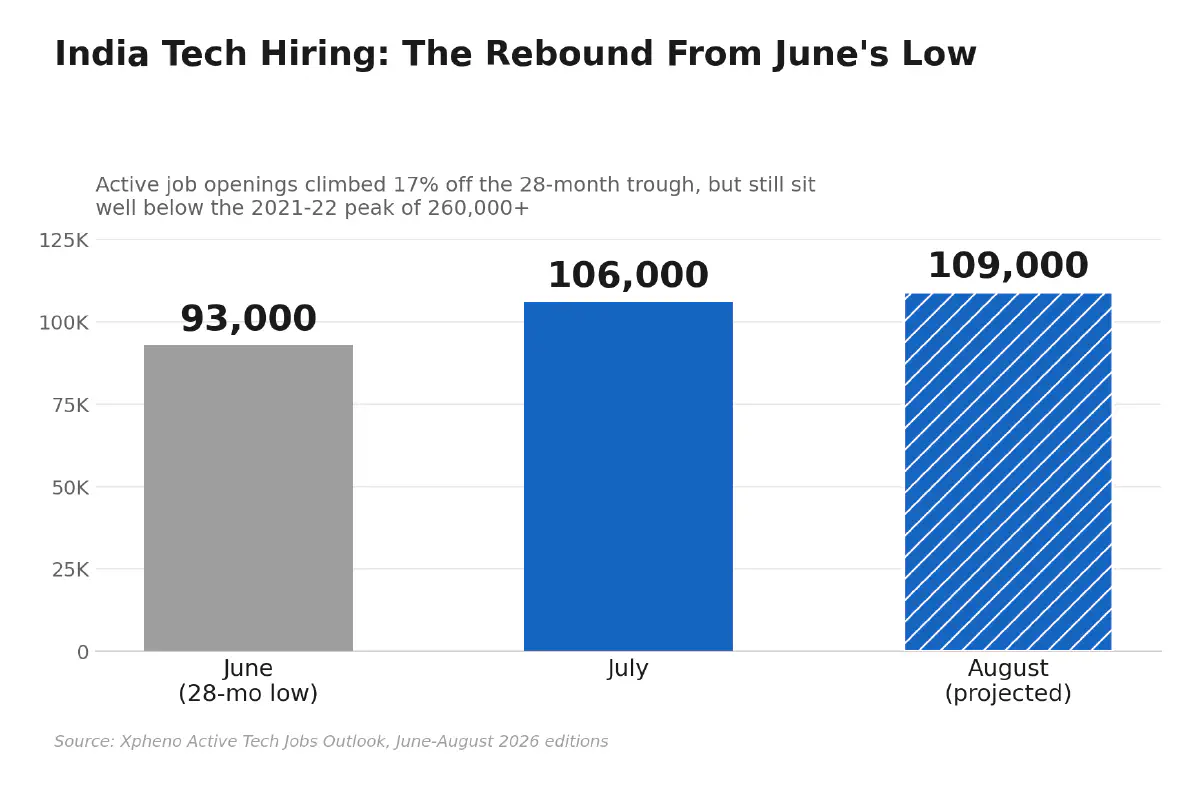
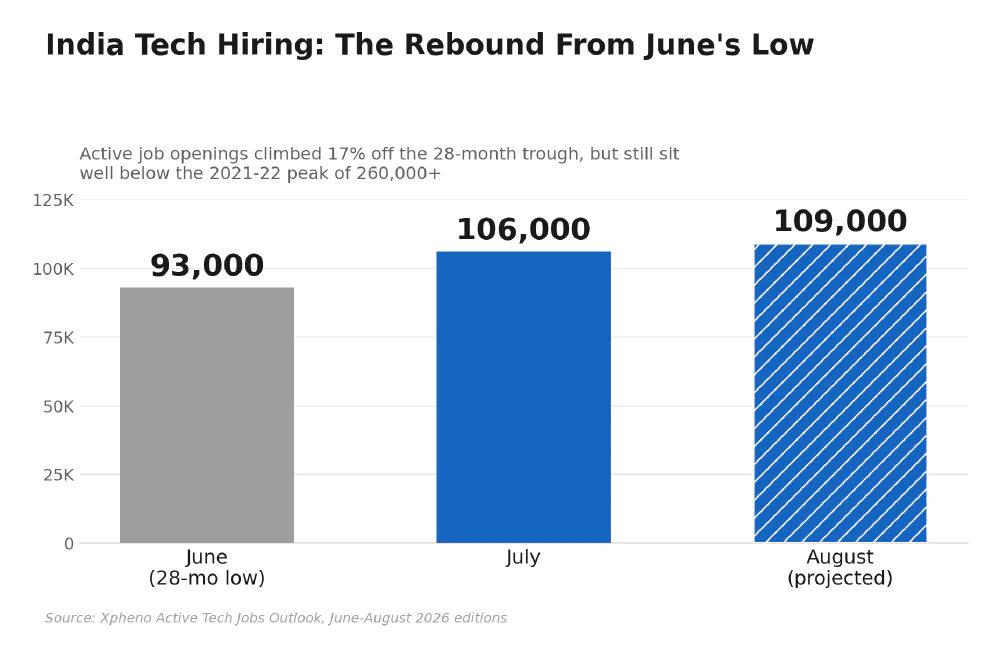
India’s tech sector hit a 28-month low in June 2026, with active openings falling to roughly 93,000, a 14% month-on-month drop and the steepest annual fall in recent memory, according to Xpheno’s Active Tech Jobs Outlook.
Since then, the recovery has been steady:
- July 2026: Active openings climbed to about 106,000, a 14% rebound from June and the first monthly rise after a sustained decline.
- August 2026: Openings are projected at roughly 109,000, a 17% improvement from the June trough, bringing hiring back toward levels last seen in April.
That’s real progress. But it’s a recovery back toward an already-modest baseline, not a return to the hiring sprees of 2021-2022, when active demand crossed 260,000 roles. Even after two months of gains, August’s 109,000 openings are still under half of that 2022 peak, at roughly 42% of it. If you’re tracking this for your own job search, read “17% rebound” as “the worst point has passed,” not “hiring is back to normal.”
The Catch: Two Very Different Hiring Tracks
This is where it gets useful rather than just reassuring.
Naukri’s June 2026 JobSpeak report found that AI hiring within IT rose 16% year-on-year, even as overall IT job listings fell 3% in the same period. Companies aren’t hiring more people overall. They’re hiring differently, and that difference is concentrated almost entirely in AI-related roles.
The effect is sharpest at entry level. Per Xpheno’s June report, entry-level hiring fell 23% month-on-month and 44% year-on-year, down to roughly 10,000 active openings, the sharpest decline of any experience band that month. Mid-senior and senior roles also fell, but nowhere near as steeply.
Fresher hiring hasn’t vanished, though. TCS, Infosys, HCLTech, and Wipro together still plan to onboard around 82,000 graduates in FY26. Industry analysis of this intake (OwnYourCareer, citing Xpheno data) describes it splitting into two bands:
- ₹3.5–6 LPA: the traditional mass-campus track, generalist roles
- ₹6–21 LPA: a smaller “AI-ready” track requiring demonstrated AI/ML deployment skills, not just coursework
I’d treat that specific pay-band split as directional rather than gospel, since it comes from one analyst’s read of the hiring plans, not an official company breakdown. But it matches what I’m seeing anecdotally from recent placements: the gap between a generic offer and a strong one is widening, and the differentiator is applied AI skill, not degree pedigree.
Why This Is Happening
A few separate forces are converging, and it’s worth untangling them:
Enterprise AI demand is real. Companies are under pressure to show AI adoption to clients, which requires people who can actually build and deploy AI systems, not just people who’ve finished an online course. This is genuine, sustained demand, not a fad.
AI-ready talent is scarce, which is slowing the whole rebound. It’s not that companies don’t want to hire. They’re struggling to find people whose AI skills are deployment-ready. This is pushing compensation up for qualified specialists and pushing companies toward internal reskilling instead of only external hiring.
Routine coding work is genuinely shrinking. Basic coding, testing, and support-ticket-style work (the traditional fresher entry point) is exactly what AI tools now handle reasonably well. That’s the direct driver behind the 44% entry-level decline, and it looks structural rather than temporary.
GCCs are outperforming traditional IT services. Xpheno’s June data shows Global Capability Centre hiring up 31% year-on-year even while the sector overall fell, the only segment posting annual growth. For engineers, that’s a real signal: GCC roles are increasingly worth targeting ahead of traditional services firms.
What This Means If You’re Job Hunting
If you’re a student or early-career engineer, “get a degree, apply to TCS” isn’t a complete strategy on its own anymore. The data draws the fork in the road fairly explicitly:
If you’re aiming for the mass-campus track (roughly ₹3.5–6 LPA): it still exists and still hires in volume. Treat it as an entry point, not a destination: plan your next move from day one rather than waiting for organic growth.
If you want the premium track, the bar is demonstrated skill, not theoretical knowledge:
- Build and deploy one real AI/ML project end-to-end, not a tutorial clone, and document it properly on GitHub.
- Get hands-on with practical LLM tooling, including prompt engineering, RAG pipelines, and basic fine-tuning, rather than just the theory covered in coursework. My free Generative AI: Zero to Job-Ready course covers exactly this if you want a structured starting point.
- Look specifically at GCC postings alongside traditional IT services firms, since the compensation and role-quality gap is real.
- If you’re already employed, push toward AI-adjacent work in your current role before you need to prove it in an interview elsewhere. Internal role redesign is quietly replacing a lot of external hiring right now.
For more on which skills actually hold up against AI disruption, see 5 Skills AI Cannot Replace.
The Honest Takeaway
Indian IT hiring is recovering, and that much of the recent headlines is accurate. But the recovery is uneven, and the unevenness is the real story. Total openings are up meaningfully from June’s low, yet the entry-level door is narrower than it was a year ago, and the premium is concentrated almost entirely in applied AI skills.
Read only the “hiring rebounds 17%” headline, and you’d relax. Read only the “entry-level down 44%” headline, and you’d panic. Neither is calibrated to what’s actually happening. The realistic read: the market is stabilizing, but around a different shape than Indian IT has run on for the last two decades: smaller entry points, higher expectations, and a real premium for people who can show AI competence, not just claim it.
Sources: Xpheno Active Tech Jobs Outlook – India (June, July, August 2026 editions); Naukri JobSpeak Index (June 2026); OwnYourCareer analysis of Xpheno fresher-hiring data (July 2026).
Disclaimer: This post is for informational and educational purposes only and does not constitute career advice. Hiring data cited is current as of August 2026 and is subject to revision as newer reports are published.